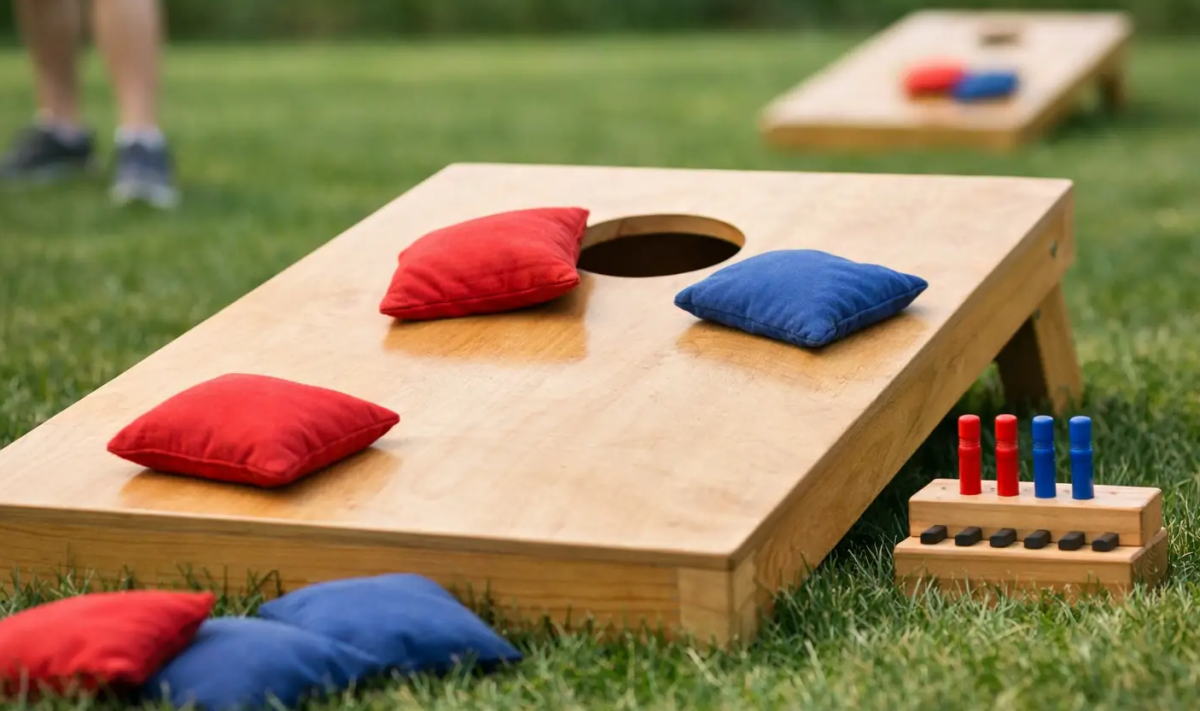
Cornhole is a backyard game built around a simple challenge: toss fabric bags toward a raised board and score points by landing them on its surface or through the hole. The basic throwing motion is easy to pick up, but accuracy takes practice. A bag that lands just below the hole can still score, block an opponent’s shot, or be pushed through by a later throw.
Under traditional cornhole rules, each side throws four bags per frame. A bag on the board earns one point, while a bag through the hole earns three. The scores are compared using cancellation scoring, and the first player or team to reach at least 21 points at the end of a frame wins.
Learning how to play cornhole also means understanding court dimensions, legal throws, player positioning, and basic strategy. These details help beginners organize a fair match and give more experienced players a foundation for competitive play.
What Is Cornhole?
Cornhole is a target game played by two individuals or two teams of two. Players toss weighted fabric bags toward an inclined board with a circular hole near its raised end. The objective is to outscore the opposition through accurate throws and strategic bag placement.
Cornhole is sometimes called bean bag toss, although that name also applies to other tossing games. Modern competitive cornhole bags typically contain plastic resin pellets rather than dried beans or corn. Synthetic filling helps maintain a consistent weight and reduces problems associated with moisture.
The game is especially popular at backyard gatherings, tailgate parties, parks, and community events across the United States. It requires little equipment or previous athletic experience. Competitive cornhole, however, demands precise releases, controlled trajectories, and tactical decisions about where each bag should land.
Bags can slide across the board, knock other bags into the hole, or push an opponent’s bag off the scoring surface. A throw that initially earns one point may become worth three after another bag strikes it. Conversely, a well-placed bag can lose its scoring position when an opponent makes contact.
Recreational players sometimes shorten the throwing distance or modify the scoring rules. Organized tournaments follow published regulations, with organizations such as the American Cornhole Organization (ACO), American Cornhole Association (ACA), and American Cornhole League (ACL) establishing their own competitive standards. Certain rules, including permitted throwing styles and match formats, differ between organizations.
Cornhole Equipment and Board Dimensions
A standard cornhole set includes two boards and eight bags, divided into two sets of four. Regulation equipment follows established dimensions to keep playing conditions consistent.
Cornhole Boards
Regulation cornhole boards have a playing surface approximately 48 inches long and 24 inches wide. The front edge sits 3 to 4 inches above the ground, while the rear rises to approximately 12 inches.
The hole measures 6 inches in diameter. Its center sits 9 inches from the upper edge and 12 inches from either side of the board.
| Component | Regulation Measurement |
| Playing surface length | 47.5–48 inches |
| Playing surface width | 23.5–24 inches |
| Hole diameter | 6 inches |
| Hole center from top edge | 9 inches |
| Hole center from side edge | 12 inches |
| Front height | 3–4 inches |
| Rear height | Approximately 12 inches |
| Distance between boards | 27 feet, front edge to front edge |
Wooden boards are standard in organized competition. Their surfaces must allow controlled sliding without excessive bouncing or unpredictable movement. Uneven finishes, exposed fasteners, and warped wood can affect how bags behave after landing.
Portable plastic boards and smaller wooden sets work for recreational games, although their playing characteristics may differ from regulation equipment.
Cornhole Bags
Each side uses four bags with a distinct color or design. Regulation bags are approximately 6 inches square and typically weigh around 16 ounces, with exact tolerances depending on the governing organization.
Modern competitive bags commonly feature durable synthetic fabric and resin filling. Many have different materials on opposite sides, giving players a faster sliding surface and a slower side for more controlled placements.
A faster side can help a bag travel toward the hole after landing, while a slower side may be preferable when placing a blocker.
Bag condition also matters. Torn seams can release filling, while damp or heavily worn fabric may change how the bag grips and slides across the board. Consistent practice requires bags of comparable weight, construction, and condition.
Additional Equipment
A tape measure helps establish the correct distance between boards. A physical or digital scoreboard makes it easier to track points during longer matches.
The playing area should also provide sufficient room for throwing motions, movement between boards, and spectators standing clear of the court.
How to Set Up a Cornhole Game
Proper court setup ensures that both sides play under the same conditions. The two main considerations are board spacing and the location of each player’s throwing area.
Positioning the Boards
Position the boards facing each other, with their lower front edges 27 feet apart. This is the standard adult throwing distance, measured between the front edges rather than between the holes or rear legs.
Both boards should rest on reasonably level ground. An unstable board can shift when struck, while a sloping playing area may affect how bags slide after landing.
A full-size court generally needs around 40 to 45 feet of length, allowing space behind the boards. Additional width is necessary for the throwing areas and safe movement around the court.
Marking the Throwing Areas
Each board has a pitcher’s box on either side. Under common competitive specifications, each box extends 4 feet along the side of the board and measures 3 feet wide.
The foul line runs across the front edge of the board at the throwing end. Players must release their bags from the assigned pitcher’s box without violating the event’s foot-placement rules.
In organized competition, the exact requirements for positioning, stepping, and releasing a bag depend on the governing rulebook. Players should check these details before participating in a tournament.
Adjusting the Distance for Beginners
The regulation distance can be challenging for children and first-time players. Recreational games often use shorter distances, such as 15 or 21 feet, to make accurate throwing easier.
Some youth and adaptive competitions also use modified distances, although the permitted measurements vary by event.
For practice, begin at a distance that allows controlled, repeatable throws. Move gradually toward the regulation setup as accuracy and throwing consistency improve.
Preparing for the First Frame
Assign each side four bags and determine who throws first. A coin toss works for casual games, while tournaments may prescribe their own starting procedures.
In singles, both competitors begin at the same board. In doubles, one member of each team stands at each end of the court.
Before the opening throw, confirm whether the match follows traditional scoring or an agreed recreational variation.
How to Play Cornhole Step by Step
A standard cornhole frame consists of eight alternating throws, four from each side. After all bags have been thrown and scored, play continues toward the opposite board.
Step 1: Choose the Starting Player
Determine who has the opening throw. The starting player stands in the assigned pitcher’s box beside one board, facing the opposite board.
The opponent occupies the other pitcher’s box at the same end of the court.
Step 2: Throw the First Bag
Hold the bag comfortably, distributing its weight across the hand. Most players use a smooth underhand motion, swinging the arm forward and releasing the bag toward the target.
A controlled toss onto the board is generally more effective than a forceful throw that overshoots it. The aim is to develop a predictable release and landing point.
An underhand toss is the conventional technique and is required under ACO rules. Other organizations, including the ACL, permit additional throwing styles under their regulations. Players should check their tournament’s rules for permitted releases, timing, and foot placement.
Step 3: Alternate Throws
After the opening throw, the opponent tosses one bag. Players continue alternating until each has thrown all four bags.
Bags remain where they land unless a rule requires their removal. Later throws can change their positions, creating opportunities to push a bag into the hole, move a blocker, or knock an opponent’s bag off the board.
Step 4: Calculate the Frame Score
Once all eight bags have come to rest, count the points earned by each side.
A bag through the hole earns three points, while a qualifying bag on the board earns one. Missed and invalid bags score zero.
Subtract the lower total from the higher one. Only the side with more points receives the difference, as explained in the scoring section below.
Step 5: Begin the Next Frame
The side that scored in the previous frame throws first in the next. If neither side earned net points, the previous starting side retains the opening throw.
In singles, both players walk to the opposite board and throw back toward the original one. In doubles, the two players already stationed at the far board conduct the next frame.
Continue until a player or team meets the winning condition for the chosen match format.
Cornhole Scoring Rules Explained
Cornhole uses cancellation scoring rather than simply adding every point earned by both sides. Understanding which bags qualify for points and how the totals are compared is essential for keeping an accurate score.
How Points Are Awarded
There are three scoring outcomes:
-
- Three points: A bag passes completely through the hole, either directly or after being pushed through by another bag.
- One point: A bag remains legally on the playing surface when scoring is finalized, without touching the ground.
- Zero points: A bag misses the board, touches the ground, or is otherwise ruled invalid.
A bag that lands on the board and subsequently slides through the hole earns three points, not four. If an opponent’s throw pushes a bag through the hole, those three points still belong to the player who originally threw it.
A bag hanging over the hole counts for one point if it remains supported by the board when scoring is finalized. If it falls completely through before the frame is scored, it earns three. Players should leave the bags undisturbed until their positions and scores have been settled.
How Cancellation Scoring Works
Each side calculates its raw points for the frame. The lower total is subtracted from the higher total, and only the difference is added to the leading side’s match score.
Consider this example:
| Result | Player A | Player B |
| Bags through the hole | 2 | 1 |
| Bags remaining on the board | 1 | 2 |
| Missed or invalid bags | 1 | 1 |
| Raw points | 7 | 5 |
| Net frame score | +2 | 0 |
Player A earns seven raw points, while Player B earns five. After cancellation, Player A adds two points to the match total.
If both players finish with equal raw scores, neither receives points for that frame. This is commonly called a wash.
When Does a Bag Become Invalid?
A bag that touches the ground before reaching the board is considered dead, even if it bounces onto the playing surface afterward. A bag resting against the board while also touching the ground does not score.
Other violations, including foot fouls and throws from an incorrect pitcher’s box, can invalidate a bag. The precise penalties and procedures depend on the competition’s rulebook.
Players should avoid moving bags before scoring is complete. Premature removal can make close positions difficult to judge.
Winning at 21 Points
Under traditional cornhole scoring rules, a player or team wins by reaching or exceeding 21 points at the end of a frame.
For example, a team starting a frame with 19 points and earning four net points finishes with 23 and wins. There is no requirement to land on exactly 21 or win by a two-point margin.
Not every competitive format follows this exact structure. The ACL’s 2026–2027 Pro rules introduce a 21 or 21 format, in which a match ends when a side reaches the scoring target or the 21-frame limit is reached. Recreational groups may also use an exact-21 requirement or impose penalties for exceeding the target.
The traditional 21-point format remains a useful starting point for learning the game. Tournament participants should confirm the applicable scoring and match-ending rules before play.
Singles vs Doubles Cornhole Rules
Singles and doubles share the same basic equipment, scoring system, and standard throwing distance. Their main differences involve player positioning and who throws during successive frames.
Singles Cornhole
Singles involves two players, each controlling four bags. Both competitors begin at the same end of the court, occupying assigned pitcher’s boxes on opposite sides of the board.
They alternate throws toward the far board. After scoring the frame, both walk to the opposite end and throw back.
In standard singles play, competitors maintain their assigned sides of the boards, following the positioning rules used for the match.
Every tactical decision belongs to the individual player. There is no partner to handle difficult board positions or adjust the approach between frames.
Doubles Cornhole
Doubles consists of two teams with two players each. One member of each team stands at one board, while the other members remain at the opposite end.
The two players at the active throwing end alternate their four bags. After the frame is scored, their partners throw the next frame in the opposite direction.
Each team throws four bags per frame, not eight. Partners remain at their assigned ends rather than switching positions after every round.
Communication becomes more important in doubles. Teammates can discuss preferred placements, opponents’ tendencies, and whether a situation calls for an aggressive scoring attempt or a defensive shot.
| Feature | Singles | Doubles |
| Total players | 2 | 4 |
| Players per team | 1 | 2 |
| Bags per side per frame | 4 | 4 |
| Throwing arrangement | Both players throw from the same end | One player from each team throws at each end |
| Movement between frames | Players walk between boards | Players remain at assigned ends |
| Traditional winning score | 21 or more | 21 or more |
Basic Cornhole Throwing Techniques and Strategies
Consistent cornhole throwing depends on a repeatable release, controlled bag rotation, and careful selection of the landing area. Different shots serve different purposes, from sliding a bag into the hole to blocking an opponent’s preferred path.
Developing a Consistent Grip
Hold the bag relatively flat in the palm instead of squeezing it into a tight ball. A relaxed grip helps the bag leave the hand without excessive folding or unpredictable rotation.
Many experienced players favor a flat, spinning release. The rotation helps stabilize the bag during flight and encourages it to land with a relatively flat profile.
The best grip depends partly on hand size and bag construction. A technique that produces consistent releases is generally more useful than one that simply imitates another player’s style.
Controlling the Throwing Motion
Begin with a balanced stance inside the pitcher’s box. Swing the throwing arm naturally toward the target, avoiding sudden acceleration or unnecessary tension.
A small forward weight shift can generate distance without relying entirely on arm strength. Follow through toward the intended landing area rather than stopping the throwing motion abruptly.
During practice, repeat the same movement across several throws before adjusting the release angle or force. This makes it easier to identify which changes improve accuracy.
Choosing the Right Trajectory
A lower, flatter throw often produces more forward movement after landing. This can help a bag slide toward the hole when the board surface and bag material provide suitable conditions.
A higher arc can help a bag land closer to its target with less forward slide, although the result depends on speed, rotation, and the board surface.
Neither trajectory works best in every situation. Bag material, board finish, humidity, and the positions of other bags all affect the outcome.
Common Cornhole Shot Types
Slide shot. The bag lands below the hole and slides upward along the board. It is a common offensive technique because a throw that lands short can still reach the hole.
Block shot. A bag is placed in front of the hole to obstruct an opponent’s preferred approach. A successful blocker may force a more difficult direct throw or an attempt to move the obstruction.
Push shot. The thrown bag strikes another bag already on the board, attempting to move it into the hole. This can turn a one-point position into a three-point result.
Airmail shot. The bag passes directly through the hole without first landing on the board. Players often use it when blockers prevent a clear sliding path.
Roll shot. An advanced throw designed to make the bag roll or flip forward after landing, potentially carrying it over a blocking bag and toward the hole. It requires careful control of the release and landing angle.
Using Strategy Instead of Chasing Every Hole
Trying to score three points on every throw is not always the strongest approach. Because cornhole uses cancellation scoring, limiting an opponent’s points can be as valuable as increasing your own total.
When protecting a lead, a player may favor consistent board placements over risky airmail attempts, depending on the opponent’s scoring opportunities. A player trailing late in a match may need more aggressive shots to create a larger scoring difference.
Bag placement also influences the next throw. A blocker may force an opponent to change trajectories, while a bag resting just below the hole can become an easy push opportunity.
The strongest decision depends on the current score, available landing areas, and the opponent’s ability to respond.
Common Mistakes Beginners Should Avoid
One frequent mistake is changing the throwing motion after every miss. Constant adjustments to grip, stance, release height, and arm speed make it difficult to develop a reliable technique.
Other problems include throwing too hard, releasing bags with inconsistent rotation, and aiming exclusively at the hole instead of choosing a practical landing area.
A useful progression is to start by landing bags consistently near the middle of the board. Once that becomes comfortable, practice controlled slides and defensive placements before attempting more difficult shots.
Reliable board placement is a stronger foundation for competitive play than occasional spectacular throws surrounded by misses.
FAQ
How Far Apart Should Cornhole Boards Be?
Regulation cornhole boards are placed 27 feet apart, measured from the front edge of one board to the front edge of the other. Recreational, youth, and adaptive games may use shorter distances, such as 15 or 21 feet.
How Many Bags Do You Throw in Cornhole?
Each side throws four bags per frame, producing eight total throws. In doubles, the players stationed at the active end throw their respective teams’ bags while their partners wait at the opposite board.
Do You Have to Get Exactly 21 Points to Win Cornhole?
No. Under traditional 21-point rules, reaching or exceeding 21 points at the end of a frame wins the game. Some competitive formats use different match-ending conditions, while an exact-21 requirement is a recreational variation.
Can You Knock an Opponent’s Bag Off the Board?
Yes. A legal throw can knock an opponent’s bag off the scoring surface, leaving it worth zero points. A throw may also accidentally push an opponent’s bag into the hole, awarding that opponent three points.
What Happens if a Cornhole Bag Hits the Ground First?
A bag that touches the ground before reaching the board is dead and earns no points, even if it bounces onto the playing surface. A bag resting against the board while touching the ground also scores zero.