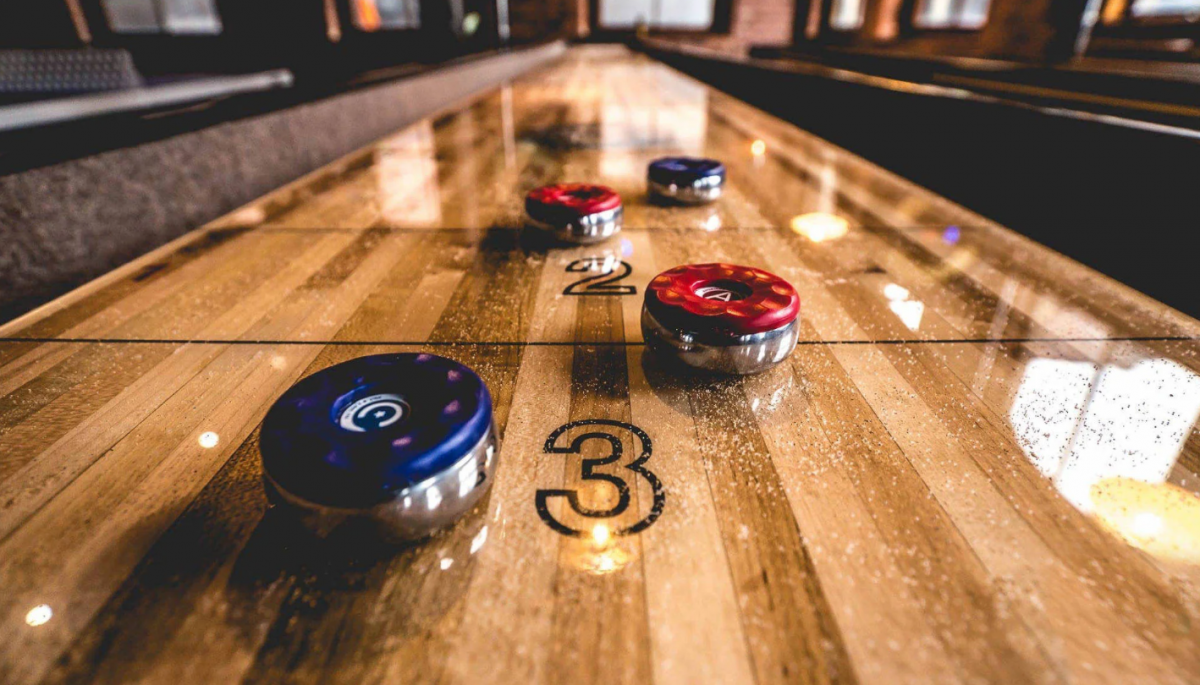
Shuffleboard looks simple: slide a puck across a smooth surface and try to land it in the right spot. Yet a well-placed shot can do more than score points. It can knock an opponent’s puck out of contention, protect another weight from a direct hit, or leave the other player with a difficult angle.
Distance control matters, but positioning often decides the outcome. The game has two main versions. Table shuffleboard uses weighted pucks on a long, narrow playing surface, while outdoor shuffleboard involves pushing larger discs across a marked court with a cue. Both demand accuracy and tactical judgment, although their equipment, scoring systems, and rules differ considerably.
Learning how to play shuffleboard begins with understanding those differences. This guide explains the rules, scoring methods, equipment, shooting techniques, and beginner strategies for both versions.
What Is Shuffleboard?
Shuffleboard is a precision game in which players propel discs or weighted pucks toward designated scoring areas. The objective is to accumulate points while limiting the opponent’s scoring opportunities. The game originated from tabletop sliding games played in England centuries ago. Over time, shuffleboard developed into several formats, including the table game commonly found in bars and recreation rooms and the larger court version played in parks, community facilities, and organized competitions.
Unlike bowling, where players aim to knock down stationary pins, shuffleboard involves pieces that remain in play throughout a round. An opponent’s disc might block a scoring opportunity or become a target for removal. Every shot changes the available options. Shuffleboard can be played individually or in teams. Players typically alternate shots using differently colored sets of weights or discs.
Different Types of Shuffleboard
The two most recognizable formats are table shuffleboard and outdoor shuffleboard. Table shuffleboard is played on a polished wooden board, usually treated with a granular lubricant that allows the weights to glide. Players release their weights by hand toward scoring zones at the opposite end. In the popular Knock-Off format, they can also displace opposing weights to improve their position. Outdoor shuffleboard, also called court or deck shuffleboard, takes place on a flat rectangular court. Players use long cues to push discs toward a triangular scoring diagram. The diagram contains positive scoring sections and a penalty area, making distance control particularly important. Table shuffleboard also includes variations such as Horse Collar and Crazy Eight, which use different objectives or scoring arrangements. The following rules cover conventional table Knock-Off and outdoor court shuffleboard. Recreational games may use modified scoring targets, shooting orders, or other house rules.
How to Play Shuffleboard Step by Step
Both versions follow a similar sequence: prepare the playing area, determine the shooting order, alternate shots, and calculate the score after all pieces have been delivered.
Step 1: Prepare the Playing Area
For table shuffleboard, check that the playing surface is clean and properly maintained. An even application of shuffleboard powder helps weights travel smoothly. Excessive or uneven powder can make their speed unpredictable. Place the weights at the shooting end and inspect the foul and scoring lines. The table should be properly installed and adjusted. Some competition tables use climatic adjusters to maintain a slight transverse curvature in the playing plank. On an outdoor court, remove debris and check that the scoring diagram and boundary lines are visible. Players use cues and discs assigned by color.
Step 2: Decide Who Shoots First
A coin toss can determine the opening order in recreational play. In table Knock-Off, the player who delivers the final weight has the hammer. This provides an advantage because the last shot can remove an opponent’s leading weight or secure a scoring position without an immediate response. Under official Shuffleboard Federation Knock-Off rules, the hammer switches after every frame. The player or team that scores must shoot first in the next frame, giving the opponent the final shot. If neither side scores, the player who previously held the hammer also shoots first, transferring the advantage to the other side. Outdoor shuffleboard follows an alternating shooting sequence. Under standard National Shuffleboard Association rules, yellow discs are played first.
Step 3: Deliver the First Shot
In table shuffleboard, hold the weight by its cap and push it along the board with a smooth, controlled motion. Release it toward the scoring end without throwing it or adding an abrupt flick. For outdoor shuffleboard, place the cue head against the disc and push forward. Keep the cue aligned with the intended path and use a steady follow-through to control distance. Beginners should develop a consistent shooting motion before experimenting with angled shots or deliberate collisions.
Step 4: Alternate Shots
Players take turns until all their designated weights or discs have been delivered. A standard table Knock-Off frame uses four weights per side, producing eight shots altogether. Players can attempt to score, knock opposing weights off the board, or position a weight to obstruct an opponent’s next shot. Outdoor singles also uses four discs per player in a typical round. Legal shots may displace discs already on the court, including the shooter’s own. A well-placed puck can still be knocked out before the round ends, so early scoring positions are never guaranteed to survive.
Step 5: Count the Points
Once the final shot has stopped, check which weights or discs are in scoring position. In table Knock-Off table, only the player or team whose leading weight is closest to the far end of the playing surface can earn points. Other weights belonging to that side also count if they lie farther toward the end than the opponent’s best weight. Outdoor shuffleboard scores eligible discs for both players independently. Discs in the 10-off area can reduce a player’s total. Record the score before removing any pieces.
Step 6: Continue Until the Game Ends
Table Knock-Off is commonly played to 15 points, although 21-point games and other targets are also used. Outdoor shuffleboard frequently uses a 75-point target, while some competitive formats determine the winner after a fixed number of frames. Before beginning, agree on the winning condition, scoring system, and any house rules.
Shuffleboard Rules and Scoring Explained
The biggest difference between the two versions is how points are awarded. Table Knock-Off allows only one side to score during a frame. Outdoor shuffleboard can award points to both players, including deductions for discs in the penalty area.
Table Shuffleboard Scoring
A conventional table shuffleboard board has scoring areas worth one, two, and three points. A weight must completely cross the relevant scoring line to receive the higher value.
| Weight position | Points |
| In the 1-point scoring area | 1 |
| Completely beyond the 2-point line, but not the 3-point line | 2 |
| Completely beyond the 3-point line without overhanging the end | 3 |
| Overhanging the far end while remaining supported | 4 |
A four-point shot is called a hanger. The weight must extend beyond the far end of the playing surface while remaining supported by the board. Overhanging a side edge does not qualify. Weights that fail to pass the required foul line are removed from play. The foul line and the boundaries between scoring zones serve different purposes and should not be confused. A weight touching a scoring line remains in the lower scoring area.
When positions are close, players may need to measure the weights before awarding points. Consider a frame in which red has weights worth three and two points, while blue’s best weight is worth one. If both red weights are closer to the scoring end than blue’s leading weight, red scores five points. Blue receives nothing. If blue’s leading weight lies between red’s three-point and two-point weights, only the three-point red weight counts. The relative order of the weights matters as much as their individual scoring zones.
Outdoor Shuffleboard Scoring
Outdoor shuffleboard uses a triangular scoring diagram divided into numbered sections.
| Scoring area | Points |
| Top triangle | +10 |
| Two middle sections | +8 |
| Two lower sections | +7 |
| 10-off penalty area | −10 |
To earn positive points, a disc must rest entirely within a scoring section without touching its boundary lines. A disc touching a scoring line does not receive the points for that section. The 10-off area follows a separate boundary rule. Under standard court shuffleboard rules, a disc incurs a ten-point penalty when it comes to rest entirely within the penalty area without touching the outer sidelines. Contact with the line separating the 10-off area from the 7-point sections does not necessarily prevent the penalty, provided the disc otherwise meets the requirements for a 10-off score. The court also has a deadline that determines whether a delivered disc has traveled far enough to remain in play.
A disc that fails to reach the required distance is removed, subject to the rules governing displaced discs. For example, a player finishing a round with one disc in the 10-point triangle, another in an 8-point section, and a third in the 10-off area receives a net score of eight points. Both players can earn positive or negative points during the same round.
Common Rules That Affect Play
Several rules influence whether a shot remains legal and how its final position is scored.
- Foul lines: In table shuffleboard, a weight must completely pass the required foul line to remain in play. Outdoor shuffleboard uses its own minimum-distance requirement.
- Scoring boundaries: Table weights must clear the appropriate scoring line to earn the higher value. Outdoor discs must satisfy the boundary rules for their scoring sections.
- Displaced pieces: Legal shots can move either player’s pieces. Their final resting positions determine the score.
- Fallen weights: A table weight that falls into the gutter or leaves the playing surface is generally out of play. Tournament rules address unusual situations involving weights displaced after coming to rest.
- Scoring disputes: Close positions should be measured before pieces are moved. Organized competitions provide procedures for resolving uncertain calls.
Recreational players can avoid most disputes by agreeing on the rules before the first frame.
Shuffleboard Equipment and Playing Surfaces
Table and outdoor shuffleboard require different equipment. Their playing surfaces, pieces, and delivery methods also affect how shots behave.
Shuffleboard Table
A shuffleboard table has a long, narrow playing plank supported by a surrounding frame called a cradle. Most tables use hardwood surfaces with a smooth, durable finish. Recreational tables come in several lengths, including 9, 12, 14, 16, and 22 feet. Tournament equipment follows stricter specifications. Under the Shuffleboard Federation’s 2024 rules, the playing plank measures 20 feet 8 inches long and 20 inches wide, while the surrounding cradle is approximately 22 feet long.
Foul and scoring lines appear near both ends. Some tables have climate adjusters beneath the plank to control its curvature as temperature and humidity change. Table shuffleboard uses metal weights, also called pucks, fitted with protective caps. Standard singles play uses four weights per player, with each side assigned a different color.
Shuffleboard powder, sometimes called wax or sand, reduces friction between the weights and the board. Modern products are typically granular lubricants rather than ordinary sand or liquid wax. Powder type and distribution influence the speed of the playing surface. Faster tables require a gentler release when aiming near the scoring end.
Shuffleboard Court
A regulation outdoor shuffleboard court is 52 feet long and 6 feet wide, with scoring diagrams at opposite ends. The marked playing area includes shooting zones, deadlines, and triangular scoring sections.
Outdoor courts are commonly made from concrete or other suitable hard materials. Their finish must allow discs to slide consistently without excessive resistance. Players shoot toward the scoring diagram at the opposite end, then reverse direction for the next round. Court shuffleboard uses larger discs and long cues rather than handheld weights.
Under USA National Shuffleboard Association specifications, standard discs measure six inches in diameter, and cues cannot exceed 6 feet 3 inches in overall length. The cue head pushes the disc along the court without lifting it. A clean, dry surface helps maintain consistent movement, while moisture or debris can alter the disc’s path.
Basic Shuffleboard Strategies for Beginners
Accurate placement gives players more options than simply hitting the highest scoring area. Good shot selection depends on the opponent’s position, the available space, and the number of shots remaining.
Learn to Control Distance
Begin by practicing shots that stop in a predictable area rather than aiming immediately for maximum points. On a shuffleboard table, maintain the same release motion while gradually adjusting the force. Observe how the weight slows as it approaches the scoring end. One useful drill is to deliver four weights toward the same scoring zone. Try to finish with a tight group instead of spreading them across the board.
Outdoor players can use a similar exercise, aiming repeatedly for the larger 7-point sections before attempting the narrower 10-point triangle. Once distance becomes predictable, introduce small changes in angle and speed.
Use Knock-Off Shots Carefully
A knock-off shot strikes an opponent’s weight to remove it from a favorable position. In table Knock-Off, displacing the leading opposing weight can determine which side scores. A direct hit may send the target into the gutter, but excessive force can also carry the shooting weight off the board. A lighter, well-aimed collision may remove the opponent’s weight while leaving the shooter’s weight in a scoring position.
Outdoor shuffleboard allows similar defensive shots. When several discs occupy nearby scoring sections, consider where both pieces will travel after contact. A poorly judged collision may improve the opponent’s position instead.
Protect Good Positions
Not every shot needs to reach the highest scoring zone. In table shuffleboard, placing a blocking weight between the opponent’s shooting end and a valuable scoring weight can make a direct knock-off more difficult.
The blocker does not guarantee protection. An opponent may approach from another angle or strike it hard enough to disturb both weights. Outdoor players can use the same principle by positioning a disc in front of a valuable scoring disc, limiting the opponent’s available approach.
Understand the Hammer Advantage
The hammer allows the player with the final shot to respond after all other weights have been delivered. A player shooting first may benefit from establishing positions that are difficult to attack. The player holding the hammer can wait for an opening, remove the opponent’s leading weight, or attempt a controlled scoring shot.
The strongest option depends on the frame. If the opponent’s best weight is difficult to remove, a more reliable scoring opportunity may be preferable to an aggressive knock-off.
Adjust to the Playing Surface
Two shuffleboard tables of identical dimensions can behave differently. Powder distribution, humidity, board curvature, and maintenance all influence weight movement. Outdoor courts also vary in speed and consistency. Use the opening practice shots to judge how pieces travel.
If a weight repeatedly curves or overshoots the target, make small adjustments to the release angle or force. Changing one element at a time makes it easier to identify what improves the result.
Common Shuffleboard Mistakes to Avoid
Most beginner errors come from misjudging scoring boundaries, choosing unsuitable shots, or using an inconsistent delivery. Using excessive force.
A table weight that travels beyond the scoring end cannot score unless it remains supported as a qualifying hanger.
On an outdoor court, an overly strong shot may leave the scoring diagram entirely. Ignoring the foul line. A weight or disc that fails to reach the required distance may be removed from play, regardless of how accurately it was aimed.
Chasing maximum points. Attempting a difficult hanger or narrow 10-point section is not always worthwhile. Consider whether a defensive shot offers a better chance of winning the round.
Changing technique between shots. Inconsistent grips, release points, and follow-throughs make distance control difficult. Maintain a repeatable motion and adjust gradually. Misreading scoring lines. Judging a puck by its center rather than its entire position can lead to incorrect scoring.
Check close calls before moving any pieces. Overlooking collision angles. A direct hit does not always produce the intended result. The shooting weight may glance off at an angle, remain in play, or move another piece into a better position.
Failing to plan the next shot. A high-scoring weight left exposed can be an easy target. Consider the opponent’s likely response before choosing where to stop. During practice, concentrate on correcting one recurring mistake at a time. Reliable shots become more useful as players learn when to use them.
FAQ
How many players can play shuffleboard?
Shuffleboard can be played in singles or doubles. Singles matches involve two players, while doubles involve two teams of two. Some recreational table formats accommodate additional participants under modified rules.
How do you win a shuffleboard game?
The winner depends on the agreed scoring format. Table Knock-Off commonly uses targets of 15 or 21 points. Outdoor shuffleboard often uses 75 points, although some competitions determine the winner after a fixed number of frames.
What is a hanger in shuffleboard?
A hanger is a table shuffleboard weight that extends beyond the far end of the playing surface while remaining supported by the board. A qualifying hanger is worth four points in standard Knock-Off scoring. Overhanging a side edge does not earn the bonus.
Can you knock your opponent’s puck off the board?
Yes. In table shuffleboard, removing an opponent’s weight is a standard defensive tactic. Outdoor shuffleboard also permits legal shots that displace opposing discs. All shots must comply with the relevant delivery and foul rules.
Is table shuffleboard the same as outdoor shuffleboard?
No. Table shuffleboard uses handheld weights on a narrow wooden board, while outdoor shuffleboard uses cues and larger discs on a marked court. Their scoring systems differ as well. Standard table Knock-Off allows only one side to score in a frame, whereas both players can score during an outdoor round.