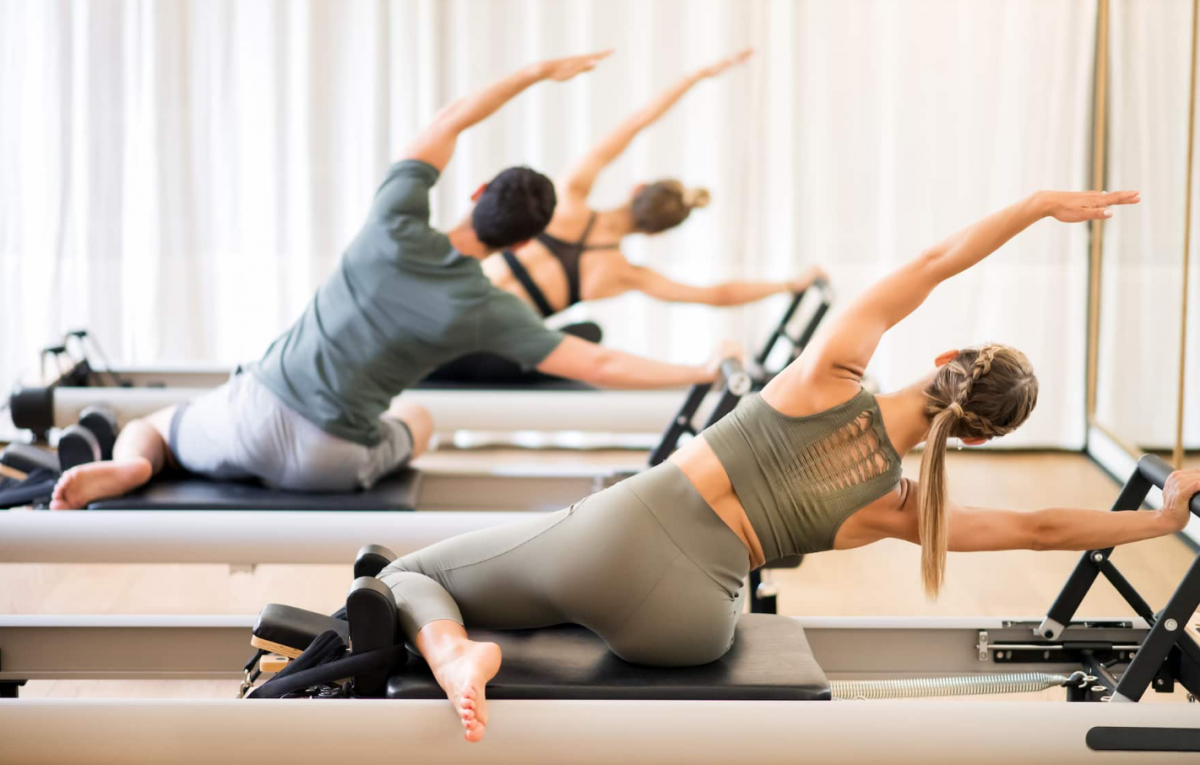
Pilates is a low-impact exercise method that improves muscle control, flexibility, balance, and coordination through deliberate movement. Instead of relying on heavy weights or fast repetitions, it emphasizes precise technique, controlled breathing, and the way different muscle groups work together.
For beginners, Pilates provides an approachable way to develop strength and mobility without the repeated impact of running or jumping. Exercises can be adjusted to accommodate different fitness levels, whether someone is returning to physical activity or adding a new form of training to an established routine. Although Pilates is commonly associated with abdominal exercises, it also works the muscles of the hips, back, shoulders, and legs.
Learning the fundamentals helps newcomers build confidence, recognize their physical limitations, and progress toward more challenging movements.
What Is Pilates and How Does It Work?
Pilates was developed by Joseph Pilates in the early 20th century. Originally known as Contrology, the method combines concentration, breathing, precise movement, and muscular control. Modern Pilates includes both traditional exercises and contemporary variations influenced by exercise science and rehabilitation practices. Movement quality is central to the method.
Many exercises require the torso to remain stable while the arms or legs move through a controlled range of motion. Even a simple leg extension performed while lying on the back becomes more demanding when the pelvis must remain steady. Six principles are commonly associated with Pilates:
- Concentration: Paying attention to body position, muscle engagement, and movement.
- Control: Performing exercises deliberately instead of relying on momentum.
- Centering: Engaging the muscles that support the abdomen, spine, and pelvis.
- Precision: Maintaining appropriate alignment throughout each movement.
- Breathing: Coordinating inhalation and exhalation with muscular effort.
- Flow: Moving smoothly between positions without unnecessary tension.
These principles are widely taught, although their interpretation varies among Pilates schools. Resistance comes from body weight, gravity, springs, elastic bands, or specialized equipment. Exercises may focus on individual movement patterns or recruit several muscle groups simultaneously. Unlike training designed primarily to maximize lifting strength, Pilates places particular emphasis on muscular endurance, coordination, and controlled movement.
Main Benefits of Pilates
Regular Pilates practice can improve muscular endurance, flexibility, balance, and movement control. Results depend on exercise selection, training frequency, starting fitness, and the difficulty of the movements.
Core Strength and Muscular Endurance
Core training is a defining feature of Pilates. The core includes the abdominal muscles, deep spinal stabilizers, diaphragm, pelvic floor, and muscles that help control the pelvis. During exercises such as the Hundred, single-leg stretch, and modified plank, these muscles stabilize the torso while the limbs move or the body maintains a position.
Holding these positions challenges muscular endurance more than maximal strength. Better-conditioned trunk muscles can make it easier to maintain stability during everyday movements and other physical activities. Pilates is particularly useful for developing controlled strength, although progressive resistance training remains more effective for maximizing muscle size and maximal strength.
Flexibility and Joint Mobility
Pilates combines strengthening exercises with movements performed through a comfortable range of motion. Spinal articulation, hip movements, and shoulder exercises help people explore ranges of motion they may rarely use during sedentary activities. The Spine
Stretch Forward involves controlled spinal flexion, while the Saw combines rotation and forward reaching. Both can contribute to flexibility when performed regularly. Flexibility describes how readily muscles and surrounding tissues allow a joint to move through its range of motion. Mobility also involves the strength and control needed to use that range actively. Pilates addresses both qualities through coordinated movement and muscular support. Improvements develop gradually.
Forcing a stretch beyond a comfortable range is unnecessary and may interfere with proper technique.
Balance and Coordination
Many Pilates movements require the torso to remain steady while the arms or legs move independently. This trains coordination and proprioception, the body’s awareness of joint position and movement. Standing exercises, single-leg movements, and controlled weight shifts challenge balance through coordinated activity at the ankles, hips, and trunk.
Mat exercises develop similar skills through alternating limb movements and breathing coordination. People primarily interested in improving standing balance should also practice upright exercises. Floor-based Pilates alone may not provide enough specific balance training.
Posture and Body Awareness
Pilates teaches participants to recognize the position of the head, rib cage, spine, and pelvis during movement. Greater body awareness may help reduce unnecessary shoulder tension and improve control of the lower back. Strengthening the trunk and upper back can also develop the endurance needed to maintain comfortable positions during prolonged activities.
Good posture does not require holding the spine in one rigid position. Natural spinal curves differ between individuals, and regularly changing positions is generally preferable to maintaining constant muscular tension.
Low-Impact Conditioning
Most Pilates exercises avoid repeated jumping and hard landings. This makes the method suitable for people who prefer low-impact workouts or want additional training between more demanding sessions. Low impact does not necessarily mean low intensity. Extended limb positions, sustained holds, and repeated controlled movements can place considerable demands on the muscles. Exercise difficulty still needs to match individual ability. Certain movements may require modification for people with injuries, movement restrictions, or medical conditions.
Mat Pilates vs Reformer Pilates
Mat Pilates and Reformer Pilates follow the same general movement principles but differ in equipment, resistance, and exercise modifications.
Mat Pilates
Mat Pilates uses body weight and gravity as its main sources of resistance. Instructors may also incorporate resistance bands, small balls, or Pilates rings. Its main advantage is accessibility. Most beginner exercises require little more than a comfortable mat and sufficient floor space. Pelvic curls, single-leg stretches, and side-lying leg lifts are common examples. Despite the minimal equipment, some mat exercises are surprisingly demanding because participants must support and stabilize their bodies without assistance.
Reformer Pilates
Reformer Pilates uses a specialized apparatus with a sliding carriage, adjustable springs, straps, shoulder blocks, and a footbar. Exercises can be performed lying down, sitting, kneeling, or standing. Spring resistance can either increase muscular demands or assist a movement, depending on the exercise and setup. A heavier spring setting does not always make an exercise more difficult. In some movements, greater resistance provides additional support or stability. The moving carriage also creates coordination challenges, making proper instruction especially valuable for beginners.
Which Type Is Better for Beginners?
| Feature | Mat Pilates | Reformer Pilates |
| Equipment | Mat and optional accessories | Specialized reformer |
| Resistance | Body weight and gravity | Springs, body weight, and gravity |
| Accessibility | Suitable for home workouts | Usually studio-based |
| Modifications | Body position and leverage | Springs, straps, and positioning |
| Cost | Generally lower | Generally higher |
| Instruction | Classes or guided home sessions | Qualified instruction recommended |
Mat Pilates is convenient for developing a home routine, while reformer classes offer adjustable resistance and equipment-based variations. For complete beginners, appropriate progressions and experienced instruction matter more than the equipment itself.
Basic Pilates Exercises for Beginners
Beginners should first become comfortable with breathing coordination, pelvic control, spinal movement, and basic stability exercises. The following movements require minimal equipment and can be adapted to different fitness levels.
Pelvic Curl
The pelvic curl develops spinal mobility while engaging the glutes, hamstrings, and abdominal muscles. How to perform it:
- Lie on your back with your knees bent and feet flat on the mat, hip-width apart.
- Rest your arms beside your body and relax your shoulders.
- Exhale, gently tilt your pelvis backward, and begin lifting your hips.
- Continue until your shoulders, hips, and knees form a roughly straight line.
- Inhale at the top, then exhale as you lower your spine and pelvis with control.
Start with 6–8 repetitions. Avoid lifting the hips so high that the lower back becomes excessively arched. The movement should feel controlled rather than forced.
The Hundred: Beginner Modification
The Hundred is a traditional Pilates exercise that develops abdominal endurance and breathing coordination. The full version involves 100 small arm pumps, divided into ten breathing cycles. Beginners can practice a shorter variation with their head and feet supported. How to perform it:
- Lie on your back with your knees bent and feet flat on the floor.
- Extend your arms alongside your body, slightly above the mat.
- Keep your head resting on the mat and gently engage your abdominal muscles.
- Pump your arms up and down using small, controlled movements.
- Inhale for five arm pumps and exhale for five.
Begin with 3–5 breathing cycles rather than completing all 100 pumps. Keep your neck relaxed and avoid pressing your lower back forcefully into the floor. As your endurance improves, progress to a tabletop leg position or lift your head and shoulders.
Single-Leg Stretch
The single-leg stretch challenges abdominal control while the legs alternate positions. For beginners, keeping the head on the mat reduces the demands on the neck and abdominal muscles. How to perform it:
- Lie on your back and bring both knees toward your chest.
- Keep your head resting on the mat and place your hands lightly on one shin.
- Extend the opposite leg outward at a height that allows your pelvis to remain steady.
- Switch legs smoothly without rocking your hips.
- Coordinate your breathing with the alternating movements.
Complete 6–10 repetitions on each side, switching legs without rushing. Extending the moving leg higher reduces the challenge. Prioritize pelvic stability rather than trying to lower the leg as far as possible.
Bird Dog
Bird Dog is commonly included in contemporary Pilates and general core training. It strengthens the trunk and hip stabilizers while challenging coordination. How to perform it:
- Begin on your hands and knees, with wrists beneath shoulders and knees beneath hips.
- Maintain a comfortable, neutral spinal position.
- Extend one arm forward and the opposite leg backward.
- Hold briefly without rotating your pelvis or arching your lower back.
- Return to the starting position and switch sides.
Complete 6–8 repetitions per side. If coordinating both limbs is difficult, practice extending one arm or one leg at a time.
Side-Lying Leg Lift
Side-lying leg lifts strengthen the hip abductors, particularly the gluteus medius, which helps stabilize the pelvis. How to perform it:
- Lie on one side with your legs extended and stacked.
- Support your head and keep your torso aligned.
- Lift the upper leg without rolling your pelvis backward.
- Pause briefly, then lower the leg slowly.
- Complete the repetitions before switching sides.
Perform 8–12 repetitions per leg. A smaller, controlled lift is more useful than raising the leg higher by twisting the torso.
Core Strength and Stability Exercises
Once foundational movements become comfortable, beginners can introduce exercises that place greater demands on abdominal endurance and coordination.
- Dead Bug. Dead Bug develops coordination between the core and limbs while training the abdominal muscles to resist excessive spinal extension. Lie on your back with your hips and knees bent at approximately 90 degrees and your arms pointing toward the ceiling. Slowly lower one arm overhead while extending the opposite leg, then return to the starting position. Keep the movement small enough to prevent excessive arching of the lower back. Perform 6–8 repetitions per side. For an easier variation, keep your arms still and lower one heel toward the floor at a time.
- Modified Forearm Plank. A modified forearm plank builds isometric endurance in the abdominal muscles, shoulders, and hips. Place your forearms and knees on the mat, keeping your elbows beneath your shoulders. Extend your body into a straight line from your head to your knees. Hold for 10–20 seconds while breathing steadily. Avoid sagging through the lower back or lifting your hips excessively. Increase the holding time gradually before progressing to a full plank supported on the toes.
- Toe Taps. Toe taps train abdominal control while the legs move independently. Lie on your back with your hips and knees bent at approximately 90 degrees. Slowly lower one foot until your toes lightly touch the mat, then return to the starting position. Alternate legs without allowing your pelvis to tilt excessively. Begin with 6–10 repetitions per side. If the exercise is too demanding, keep one foot on the floor while moving the opposite leg.
Flexibility and Mobility Exercises
The following movements focus on comfortable spinal mobility, controlled rotation, and lateral flexibility.
- Cat-Cow. Cat-Cow is commonly used in contemporary Pilates warm-ups to encourage spinal movement. Begin on your hands and knees. Exhale as you round your spine and allow your head to follow the movement. Inhale as you gently extend your spine, lifting your chest without forcing the lower back. Repeat 6–10 times at a relaxed pace. Distribute the movement throughout the spine instead of concentrating it entirely in the neck or lower back.
- Spine Stretch Forward. Sit upright with your legs extended in front of you and separated slightly wider than hip-width. Reach your arms forward at shoulder height. Exhale as you gradually round your spine, reaching forward without collapsing your shoulders. Inhale as you return to an upright position. Repeat 5–8 times. If tight hamstrings make sitting upright uncomfortable, bend your knees slightly or sit on a folded towel.
- Mermaid Stretch. The Mermaid is a seated side-bending exercise that encourages movement through the ribs and trunk. Sit cross-legged or with both legs folded to one side. Place one hand on the mat for support and reach the opposite arm overhead. Bend gently toward the supporting hand, keeping the movement comfortable through your ribs and waist. Return to the center and repeat on the other side. Perform 4–6 repetitions per side. Avoid forcing the supporting shoulder downward or twisting your torso to create a deeper stretch.
- Saw. The Saw combines spinal rotation with forward reaching. Sit upright with your legs extended and separated. Stretch your arms out to the sides, rotate your torso, and reach one hand toward the opposite foot while rounding forward. Keep your sitting bones grounded as you rotate, and avoid forcing the reach toward your foot. Return to an upright position before switching sides. Complete 4–6 repetitions in each direction. Use a smaller range of motion if necessary. The movement should create a manageable stretch rather than sharp discomfort.
How to Start Pilates at Home
Home Pilates requires little equipment. A supportive exercise mat, comfortable clothing, and enough room to extend your arms and legs are sufficient for most introductory routines.
Build a Short Beginner Routine
A 15–25-minute session provides time to practice several movement patterns without making the workout unnecessarily demanding. This example combines spinal mobility, abdominal endurance, and hip control.
| Exercise | Starting Volume |
| Cat-Cow | 6–8 repetitions |
| Pelvic Curl | 8 repetitions |
| Modified Hundred | 3–5 breathing cycles |
| Toe Taps | 6–8 per side |
| Bird Dog | 6 per side |
| Side-Lying Leg Lift | 8 per side |
| Mermaid Stretch | 4 per side |
Take short breaks when breathing becomes difficult to coordinate or technique begins to deteriorate. The session does not need to feel exhausting. For beginners, completing movements accurately and consistently is more productive than rushing through additional repetitions.
Focus on Technique Before Progression
Exercise difficulty should increase only when the current variation can be performed with consistent control. Progression may involve:
- Adding repetitions without sacrificing technique.
- Holding positions for longer periods.
- Changing arm or leg positions to increase leverage.
- Introducing resistance bands or small accessories.
- Moving to more challenging exercise variations.
Adjusting one or two variables at a time makes it easier to recognize when an exercise becomes too demanding. Muscular fatigue is normal, but sharp pain, dizziness, or unusual discomfort are reasons to stop. People with significant injuries, recent surgery, pregnancy-related restrictions, or conditions affecting movement may need individualized modifications from an appropriately qualified professional.
Pilates vs Yoga: Key Differences
Pilates and yoga share several features, including controlled breathing, body awareness, and mat-based movements. Their origins and teaching approaches, however, are different. Pilates was developed as a physical conditioning system centered on muscular control, strength, and coordinated movement. Yoga encompasses a much broader range of traditions originating in ancient India.
Depending on the style, practice may include physical postures, breathing techniques, meditation, and philosophical disciplines.
| Aspect | Pilates | Yoga |
| Origins | Developed by Joseph Pilates in the 20th century | Rooted in traditions originating in ancient India |
| Primary emphasis | Muscular control, strength, coordination, and mobility | Varies by tradition; may include postures, breathing, and meditation |
| Typical movements | Controlled repetitions and exercise sequences | Held postures, flowing sequences, or both |
| Breathing | Coordinated with movement and trunk control | Includes various breathing techniques |
| Equipment | Mats, accessories, and specialized apparatus | Usually mats and optional props |
| Training intensity | Depends on exercise and class format | Varies widely by style and class format |
The distinction is not absolute. Many yoga classes develop considerable strength and balance, while Pilates sessions may incorporate relaxation and mindful attention. Pilates often appeals to people who prefer structured physical exercises with a clear focus on muscular control.
Yoga may be more attractive to those interested in combining movement with meditation, breathing practices, or traditional elements. Both can contribute to a balanced fitness routine.
How Often Should Beginners Practice Pilates?
Two or three Pilates sessions per week is a reasonable starting point for many beginners. This provides regular opportunities to practice technique while allowing recovery between demanding workouts.
Someone returning to exercise after a long break may prefer shorter sessions. A practical schedule could include two 20-minute mat workouts and one optional longer class. Training frequency can increase as coordination and muscular endurance improve.
However, more demanding exercises may require additional recovery, particularly when they repeatedly challenge the same muscle groups. Pilates also complements walking, cycling, swimming, and resistance training. It should not automatically replace aerobic exercise or other forms of strength training.
FAQ
Is Pilates good for complete beginners?
Yes. Pilates can be adapted for people with little or no previous exercise experience. Beginner classes typically introduce breathing coordination, pelvic control, spinal mobility, and basic strengthening movements before progressing to more demanding exercises. Modified variations and qualified instruction can make learning the technique easier.
Can Pilates help build muscle?
Pilates improves muscular endurance and may support muscle growth in previously inactive individuals when exercises provide sufficient resistance and progressively greater challenges. However, traditional Pilates is generally less effective for maximizing muscle size or maximal strength than progressive resistance training with challenging loads.
Can Pilates help with weight loss?
Pilates contributes to physical activity and energy expenditure, but changes in body weight depend largely on overall energy balance. Many beginner sessions burn fewer calories than vigorous aerobic workouts. Pilates can support a broader fitness routine, although it is not a guaranteed weight-loss method.
Do you need equipment to practice Pilates?
No. Mat Pilates uses body weight and gravity, so a comfortable exercise mat is usually enough to begin. Resistance bands, Pilates rings, and small balls can introduce additional variations later. Reformer Pilates requires specialized equipment.
How long does it take to see results from Pilates?
Beginners may notice better coordination and body awareness within their first few sessions. Improvements in muscular endurance, flexibility, and balance generally develop over several weeks of consistent practice. Progress depends on starting fitness, exercise difficulty, training frequency, and individual response.